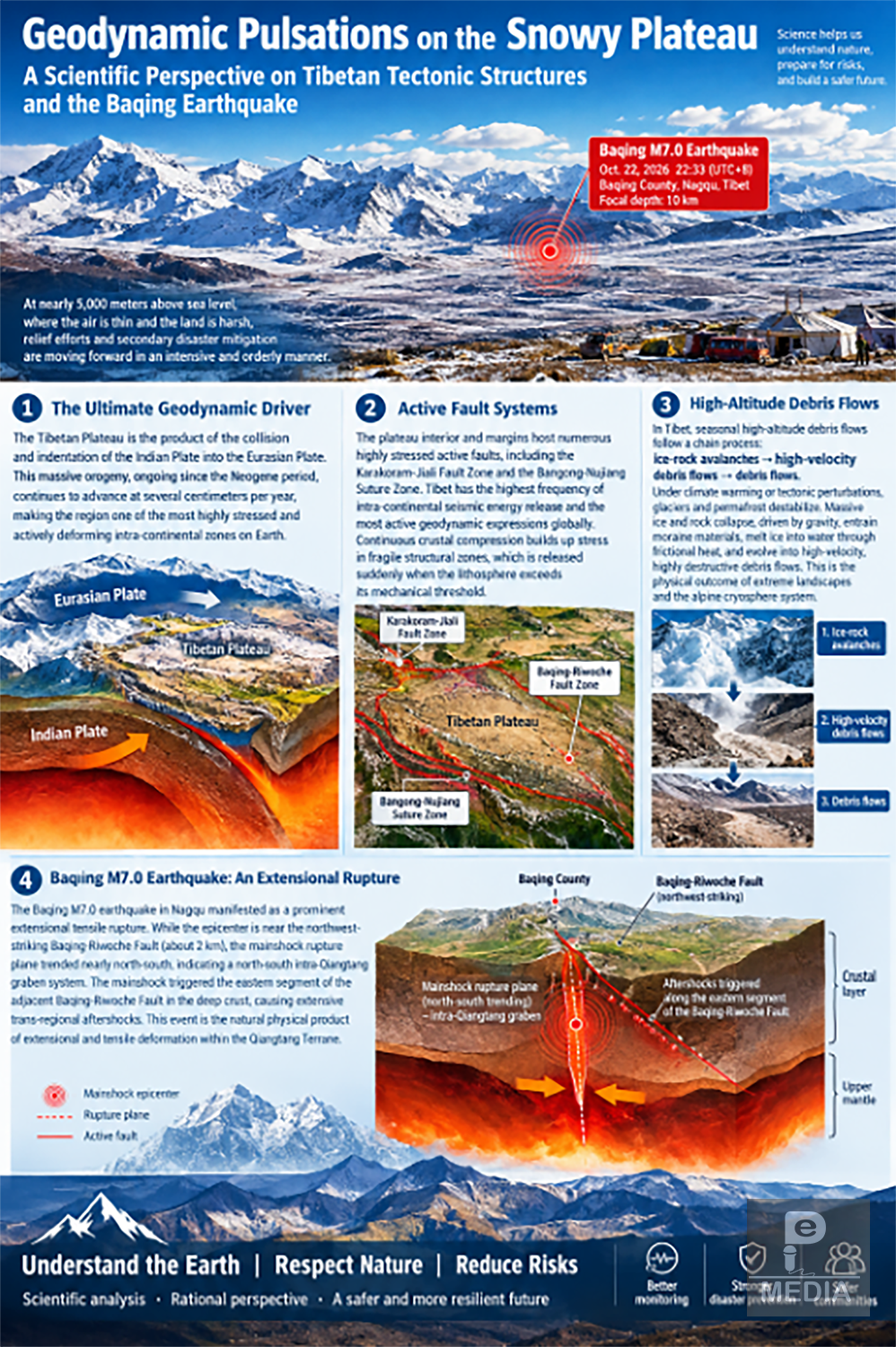
On October 22, 2026, at 22:33 UTC+8, a magnitude 7.0 earthquake struck Baqing County, Nagqu, Tibet, at a focal depth of 10 kilometers. In an extreme geographic environment characterized by an average altitude of nearly 5,000 meters and severe high-altitude hypoxia, earthquake relief efforts and secondary disaster mitigation are progressing in an intensive and orderly manner. Facing such intense crustal activity on the snow-covered plateau, a rational analysis of the generation mechanisms and evolutionary patterns of alpine natural hazards—conducted from the professional standpoint of empirical geosciences and structural geology—constitutes the foundational cornerstone for scientific disaster prevention and reduction.
From the objective perspective of morphotectonics and regional geology, the frequent occurrence of earthquakes, landslides, and high-altitude debris flows in Tibet represents a natural evolutionary trajectory governed concurrently by its unique geographical positioning, plate tectonic mechanisms, and extreme alpine climate.
To comprehend the geological activity of the Tibetan Plateau, one must broaden the analytical scope to the scale of global plate tectonics:
• The Ultimate Geodynamic Driver: As the world’s most active “Roof of the World” since the Neogene period, the Tibetan Plateau is situated at the leading edge of the convergent uplift zone driven by the intense collision and sustained indentation of the Indian plate into the Eurasian plate. This macro-scale orogeny—the most massive in human history spanning tens of millions of years—continues to advance at a rate of several centimeters per year, rendering this region one of the most highly stressed and intensely deforming intra-continental geodynamic zones globally.
• Structural Fault Systems: Against the macro-tectonic backdrop of rigid, dual-plate collision, a multitude of expansive, highly stressed active structural fault systems have developed within the interior and along the margins of the plateau, including the Karakoram-Jiali Fault Zone and the Bangong-Nujiang Suture Zone. Consequently, Tibet has intrinsically become a region with the highest frequency of intra-continental seismic energy release and the most active geodynamic expressions globally. Under long-term, sustained crustal compression, tectonic stress continuously accumulates within these fragile structural zones. Once it surpasses the mechanical yielding threshold of the lithospheric rocks, it is abruptly discharged in the form of high-magnitude earthquakes.
Beyond seismicity, the high-altitude debris flows that frequently occur during specific seasons in Tibet bear distinct geographical and climatological imprints. In geomorphological science, these events are classified as chain disasters characterized by a sequential progression of “high-altitude ice-rock avalanches — high-velocity debris flows — debris flows.” Under the compounding effects of global climate warming or tectonic perturbations, massive glaciers and alpine mountain permafrost at high elevations undergo sudden destabilization. Driven by the gravitational potential energy of kilometer-scale topographic relief, the collapsing mass instantaneously converts into catastrophic kinetic energy. This descending mass intensely entrains and “erodes” the loose moraine materials left behind by ancient glacial ablation within the channels. The volume of the cascading material amplifies geometrically during high-velocity transit, and the intense frictional heat generated during the motion melts the ice components into water. The resulting mixture of water, mud, and rock aggregates ultimately evolves into a high-velocity, high-destructive debris flow. The evolution of this high-altitude disaster chain is entirely the physical outcome of the interaction between extreme landscapes and the alpine cryosphere system.
In response to the newly erupted magnitude 7.0 earthquake in Baqing, Nagqu, Tibet, deep analytical insights provided by experts in the geological community have further illuminated the complexity and objectivity of deep crustal deformation within the plateau interior. This Baqing M7.0 earthquake manifested as a prominent extensional tensile rupture. Correlating the spatial distribution of the aftershock sequence with the focal mechanism solution of the mainshock reveals that although the epicenter is adjacent to the northwest-striking Baqing-Riwoche Fault (with a linear distance of approximately 2 km), the rupture plane of the mainshock trended nearly north-south. This structural geometry indicates that the mainshock actually ruptured an intra-Qiangtang, north-south-trending blind graben system. The instantaneous Coulomb stress changes induced by the mainshock sequentially triggered and activated the eastern segment of the adjacent Baqing-Riwoche Fault within the deep crust, thereby inducing extensive trans-regional aftershock activities. This Baqing seismic event is precisely the natural physical product of such extensional and tensile deformations operating within the interior of the Qiangtang Terrane.
Recruitment Opportunity
WORK TOTALLY OFFICIAL * HIGHLY REPUTED ORGANISATION *
Prosperous Era Media Pvt Ltd *
URGENT MOVE * MALE or FEMALE *
JOB OPENINGS: News Assistant * Researcher * Administrator * Social Media Editor * Events Specialist *
WORK DETAIL: Outdoor work / Action / Adaptability / Persistence
INCOME: Monthly salary 6000 / - to 20000 / -as per work
BENEFITS: Flexible working & enjoyable vacation (your second job)
LOCATION: NER (Distributed nearby)
AGE: 25 to 45 year
EDU: 10th, 12th to any degree
REQUIREMENTS: Strong sense of responsibility / communication and coordination / teamwork *
Fresher and Experienced both can apply *
WARNING: Impolite, distrustful, and malicious doubters are not welcome
Interested person plz send your resume to E-mail: [email protected] / [email protected]