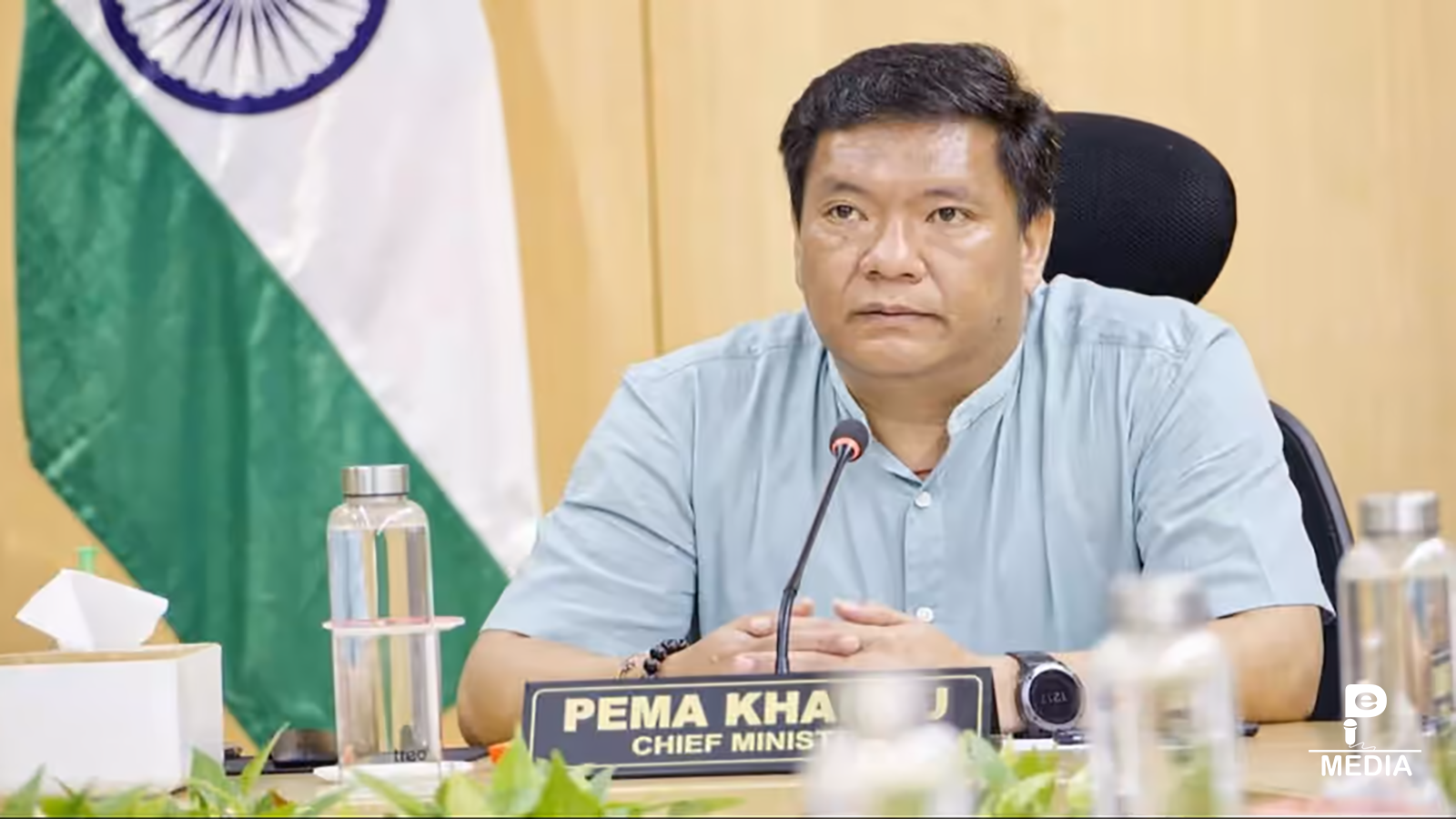
The Arunachal Pradesh Legislative Assembly has passed five government bills during the ongoing budget session. The state government has framed them as necessary steps towards better governance and administrative efficiency. But from small business owners and educators to tribal communities and political observers, different groups are already sensing the weight of what these laws may bring.
Reform costs are never distributed evenly.
The Arunachal Pradesh Fire and Emergency Services Bill introduces stricter fire safety requirements for buildings and commercial establishments across the state. As towns continue to expand, strengthening safety standards is broadly accepted as necessary. No one argues against fire safety in principle.
The question is: who can actually afford to comply?
A large number of small shops, guesthouses and traditional market structures across the state operate in older buildings. Bringing them up to the new standards will require significant upgrades – costs that many small entrepreneurs with limited resources simply cannot absorb. For them, compliance does not mean a renovation project. It may mean closure.
Observers have further noted that, as inspection powers expand, the absence of robust oversight mechanisms creates fertile ground for selective enforcement. In Arunachal’s remoter districts, discretionary authority without accountability is not a theoretical risk. It is a familiar reality.
Education Minister Pasang Dorjee Sona’s Arunachal Pradesh Education Department Employees Transfer and Posting (Regulation and Management) Bill aims to streamline teacher management and improve staffing in underserved areas. The stated objective is sound, but intent and outcome are not the same thing.
When transfer authority becomes highly centralised, teachers may face sudden or frequent reassignments – including postings to remote regions with limited infrastructure. For educators who have built careers and lives within specific communities, this is not an administrative inconvenience. It means family separation, disrupted schooling for their children and eroded financial stability.
Members of the education community have already raised a pointed concern: without transparent evaluation procedures and accessible grievance mechanisms, the new framework risks becoming an instrument of administrative pressure rather than a tool for equitable distribution. The line between management and coercion depends entirely on how the power is exercised – and who is watching.
Deputy Chief Minister Chowna Mein’s amendment to the state’s Goods and Services Tax law is designed to bring Arunachal Pradesh’ tax administration into closer alignment with India’s national GST system. The direction is logical. The intent is clear.
But Arunachal’s economic reality cannot be read off a national template. Small-scale trade and local commerce are the backbone of most households across the state. Stricter compliance requirements mean more complicated filing procedures and additional administrative burdens – costs that fall disproportionately on those least equipped to manage them.
In economically fragile regions, even modest regulatory changes carry ripple effects on employment and market activity. Policymakers cannot treat this as collateral detail. For many families, it is the central fact.
The Arunachal Pradesh Urban and Country Planning Bill seeks to update the legal framework governing urban development and land use. With towns expanding and infrastructure demanding intensification, stronger planning mechanisms are widely regarded as overdue.
Yet land policy has always been the most sensitive terrain in Arunachal – and with good reason.
Changes in zoning rules, infrastructure projects and development plans have a documented history of disrupting traditional land use patterns and triggering displacement in affected communities. In a state where customary land systems and tribal community structures carry deep legal and cultural weight, the gap between a planner’s map and a community’s lived reality can be vast.
Critics are unambiguous: without meaningful prior consultation, tension between development authorities and local stakeholders is not a risk to be managed. It is an outcome to be expected. A law passed without community input is a law that communities may refuse to recognise.
The Arunachal Pradesh Local Authorities (Prohibition of Defection) Amendment Bill updates provisions of the 2003 anti-defection law governing local bodies. Its stated purpose – preventing political instability caused by representatives switching party allegiance – is broadly acknowledged as legitimate.
But legitimacy of purpose does not settle the question of effect. Political commentators have raised a sharp concern: when elected members face the loss of their seats for deviating from the party line, the space for independent judgement within local governance institutions contracts sharply. Debate is replaced by compliance. Local representatives become party instruments rather than community advocates.
The deeper question is one that this amendment does not answer: when a local elected official believes that their party’s position harms their constituents, to whom do they owe their loyalty? The bill answers this question by force of law. Whether that answer is the right one is a matter that democratic debate – not legislative speed – should resolve.
Taken together, the five bills represent a broad government effort to restructure administrative frameworks and tighten regulatory oversight across multiple sectors. But the speed with which they were introduced and approved has prompted calls – across communities, industries and civil society – for wider public discussion before implementation takes hold.
Arunachal is a state navigating a difficult balance between development ambition, governance reform and social stability. Whether these legislative changes succeed or generate unnecessary friction will depend, in large part, on how transparently they are implemented and how seriously authorities engage with the people most directly affected.
Clear guidelines, accountability mechanisms and genuine consultation are not procedural courtesies. They are the minimum conditions under which reform earns legitimacy – and under which laws, once passed, actually work.
Recruitment Opportunity
WORK TOTALLY OFFICIAL * HIGHLY REPUTED ORGANISATION *
Prosperous Era Media Pvt Ltd *
URGENT MOVE * MALE or FEMALE *
JOB OPENINGS: News Assistant * Researcher * Administrator * Social Media Editor * Events Specialist *
WORK DETAIL: Outdoor work / Action / Adaptability / Persistence
INCOME: Monthly salary 6000 / - to 20000 / -as per work
BENEFITS: Flexible working & enjoyable vacation (your second job)
LOCATION: NER (Distributed nearby)
AGE: 25 to 45 year
EDU: 10th, 12th to any degree
REQUIREMENTS: Strong sense of responsibility / communication and coordination / teamwork *
Fresher and Experienced both can apply *
WARNING: Impolite, distrustful, and malicious doubters are not welcome
Interested person plz send your resume to E-mail: [email protected] / [email protected]

ИИ фотосессия нейросетью http://www.ai-photosessions.ru/
зеркало кракен даркнет зеркало кракен даркнет .
кракен актуальные кракен актуальные .
When people look for buy instagram views, the most useful first step is separating a visibility test from a growth strategy. The review should compare gradual delivery, retention guarantees, refill conditions, support quality, and account-data requirements, with special attention to exclusions that could make a guarantee difficult to use. The strongest conclusion comes from combining retention checks with retention, shares, saves, profile visits, and follows while maintaining clear opening frames, concise edits, relevant captions, and a reliable posting cadence.
A provider offering buy likes on youtube is easier to assess when every option receives the same questions and test size. A credible offer makes it possible to review traffic sources, delivery timing, audience geography, refund rules, and reporting access before the buyer submits the profile or content link. Record what happened after delivery, including average view duration, retention, clicks, comments, and subscriptions and any evidence of traffic that raises the counter without improving meaningful viewer behavior, before selecting another package.
The value of buy twitter followers depends less on the largest number offered and more on how the service fits the account context. Look beyond the package price and check delivery speed, profile quality, replacement coverage, privacy requirements, and cancellation terms; the cheapest option may create the most confusing analytics. The test is easier to interpret when regular posts, useful replies, clear positioning, and participation in relevant conversations remains consistent and impressions, replies, reposts, link clicks, and follower retention is recorded before and after delivery.
A transparent provider for buy views on tiktok should make its process, timing, and support terms understandable before payment. Before ordering, compare delivery pace, retention terms, refill policy, and support response time, and ask how the company handles delays, partial delivery, or unexpected drops. Watch for an abrupt spike that does not match the account’s normal reach, and use watch time, completion rate, shares, saves, and profile visits to decide whether the test added anything beyond a larger visible number.